AI / COMMUNITY
FloodWatch Fiji
An AI-powered flood risk prediction and community alert system for Fiji. It brings weather observations, risk maps and local warnings into one place.
- My role
- Project Manager, AI/ML and Backend Engineer
- Status
- Public course project · IS314
- Stack
- Python · FastAPI · React · PostgreSQL · Machine learning
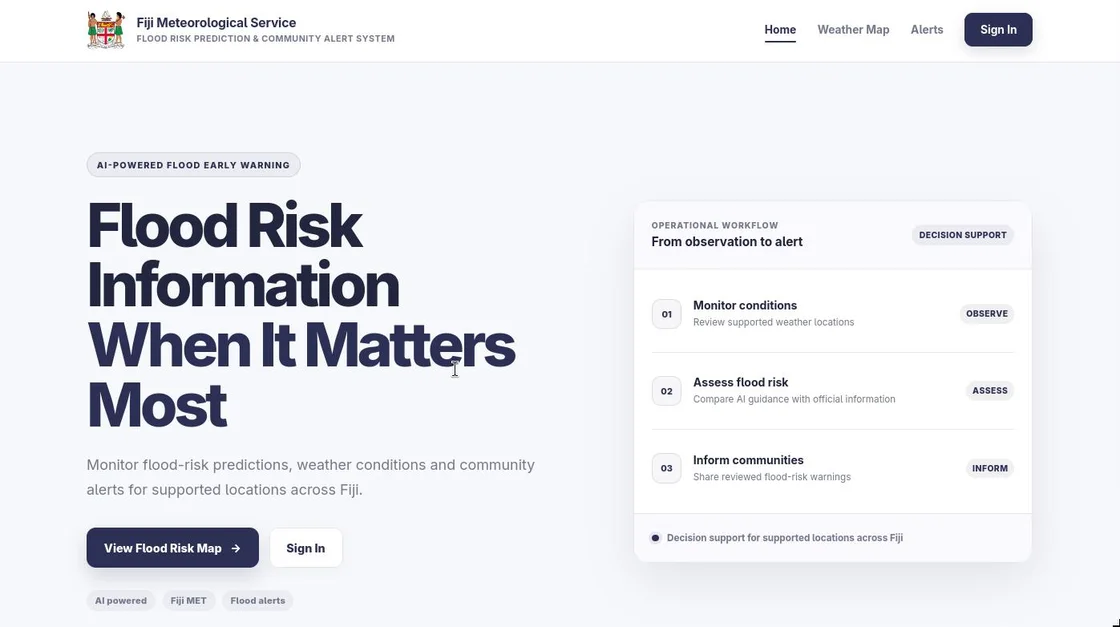
The problem
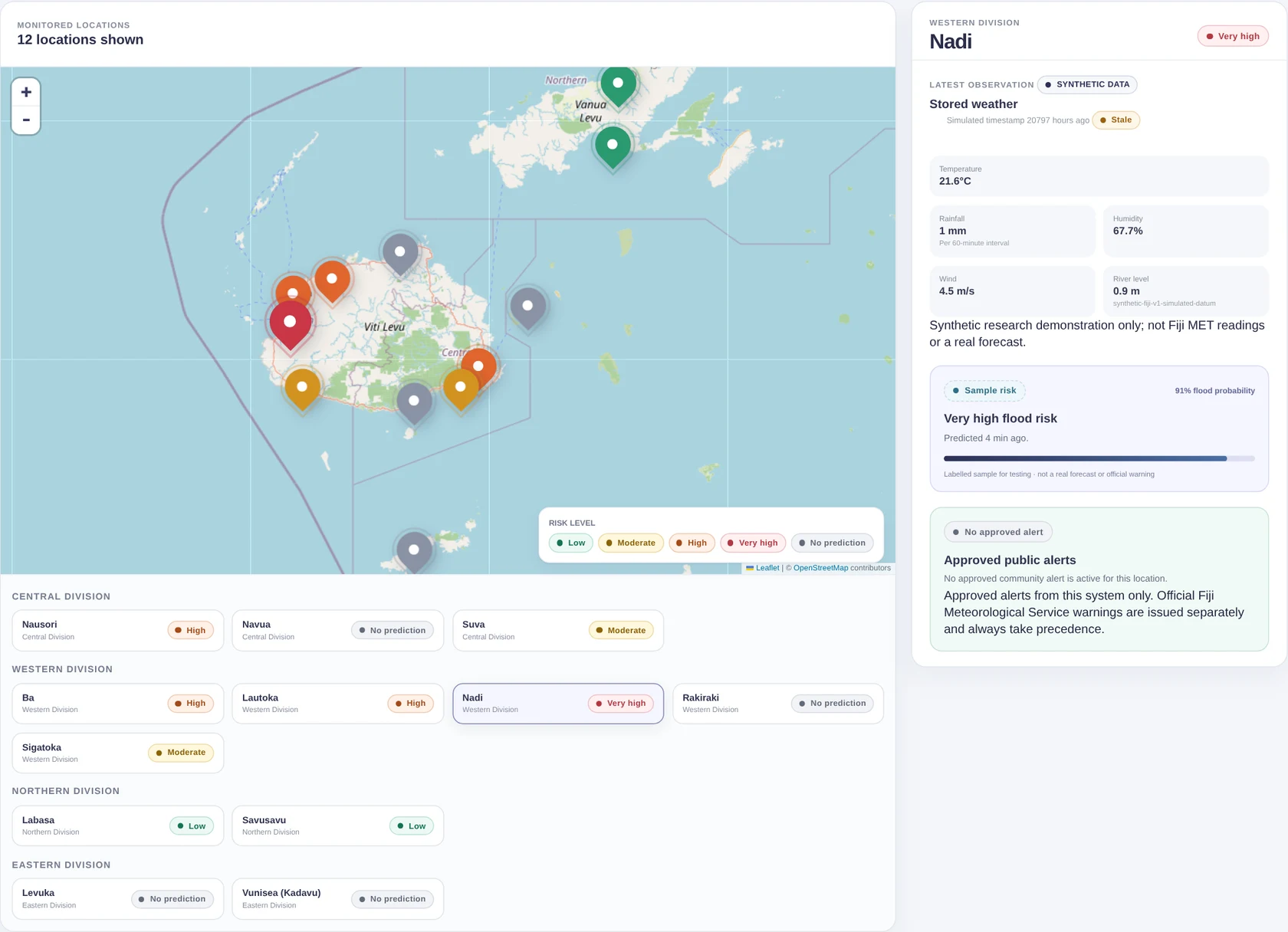
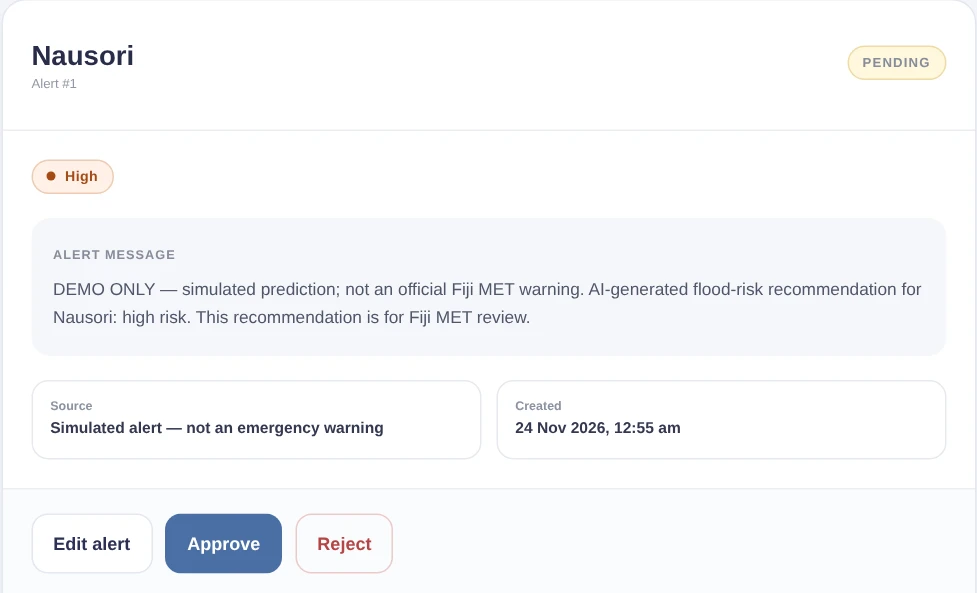
A resident checking on a town needs to know where a report came from, how old it is and whether anyone has reviewed it. Our course project brought those questions into one map and gave administrators a separate place to review community alerts.
My contribution
I built the synthetic Fiji simulator and training pipeline, connected stored weather to model inference, and implemented saved-location alerts and the administrator review interface. Teammates contributed the first Leaflet map, location registry and community alert API integration.
Architecture
Weather history
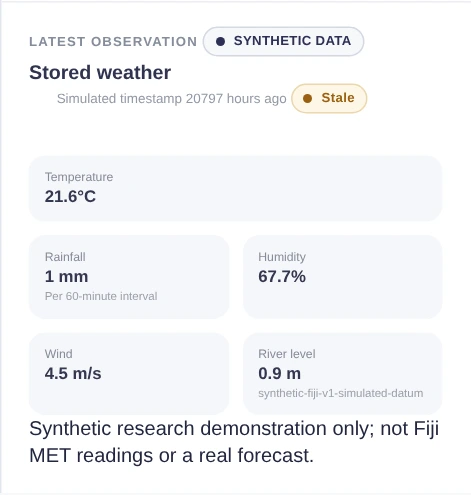
PostgreSQL stores time-stamped observations with their location, units and source. Generated weather has its own records.
FastAPI services
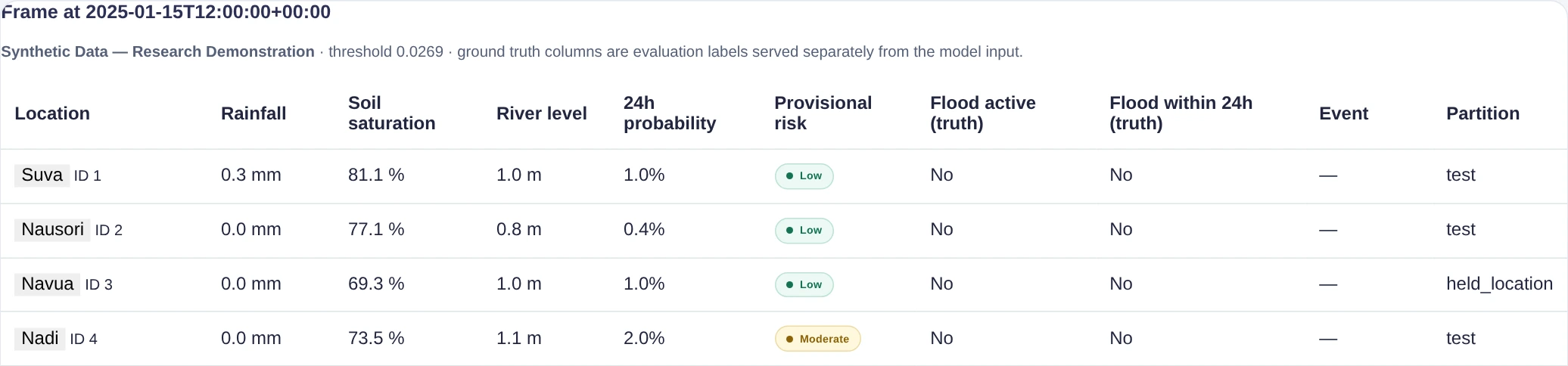
Separate endpoints serve weather, alerts and research predictions. The prediction service reads compatible synthetic history and runs the saved CatBoost model to estimate flood onset in the next 24 hours.
Community view
React reads locations, weather and approved alerts through the API. Leaflet places them on the map. A research prediction stays in the demo workflow.
Engineering challenges
Test on unfamiliar storms
The training protocol separates records by time and holds out three locations and selected simulated storms. Model selection uses a fixed false-alert budget. This tests how the model handles new simulator conditions before anyone interprets a score as evidence about Fiji weather.
Reconstruct the past without reading the future
At each forecast time the service requires 175 consecutive hourly records. That gives it a week of history plus time to handle missing readings. It builds the same 56 inputs used in training, carrying measurements forward for at most six hours.
Keep a rehearsal out of the alert feed
Approving a simulated alert updates separate database tables. Community notifications use an outbox for approved operational alerts. A reviewer can exercise the demo workflow without sending a warning to someone following that location.
Project gallery
Testing and results
Two checks passed with the saved V1 model and synthetic dataset. The first reproduced training-pipeline inputs and probabilities across 12 locations. The second approved a synthetic alert and verified that the operational feed stayed empty. Forecasting skill on observed Fiji floods remains unvalidated.
What I learned
A probability needs context wherever it appears. Carrying the source and timestamp from storage to the map helps a reader judge what a forecast can support.